
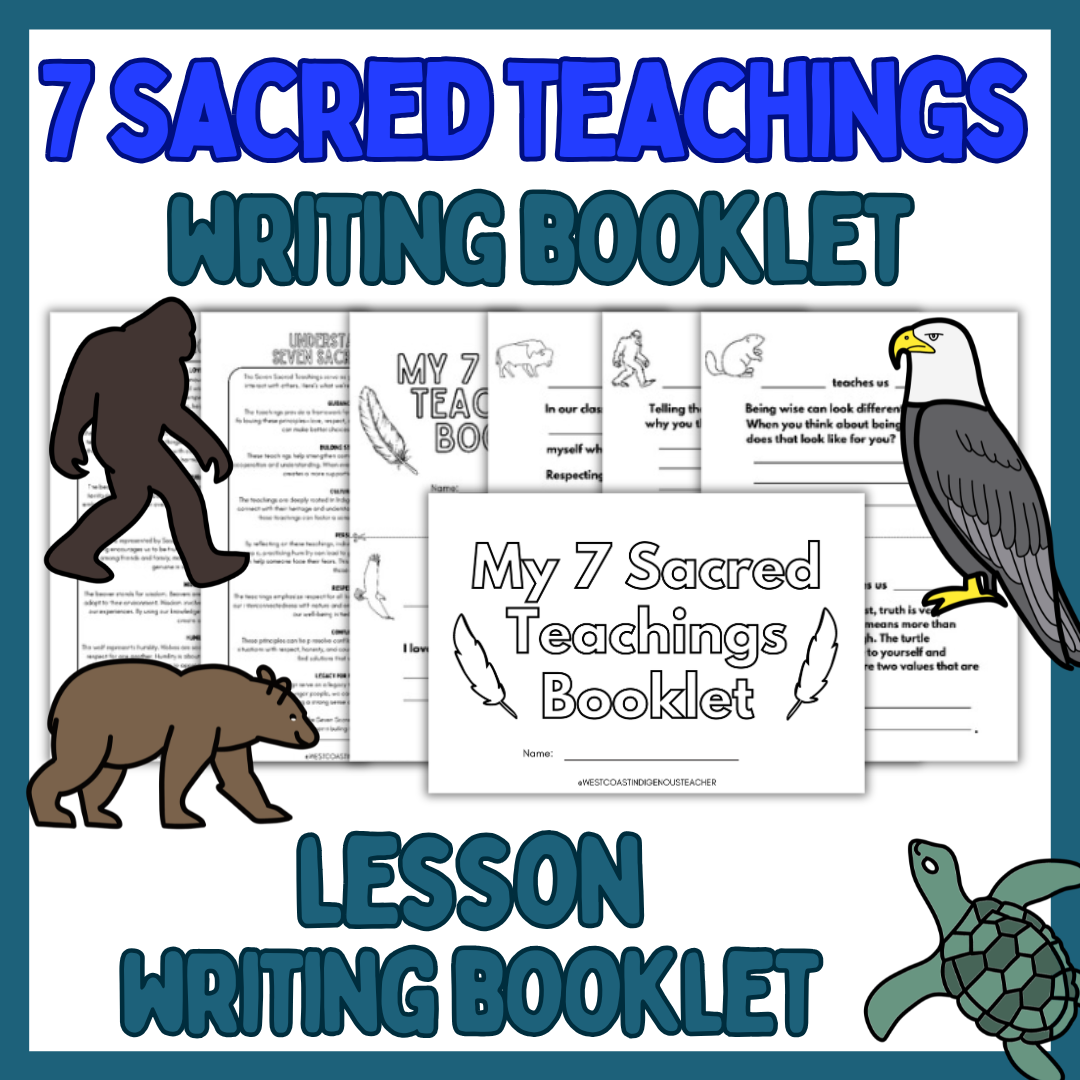

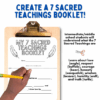

Looking for a meaningful Seven Sacred Teachings lesson for intermediate students? This printable lesson and student booklet introduce the seven teachings and help students consider how they can apply each one in their everyday lives.
Students learn about love, respect, courage, honesty, wisdom, humility and truth. They then complete fill-in-the-blank booklet pages, written reflections and real-life classroom scenarios that encourage personal connections and thoughtful discussion.
Explore the Seven Sacred Teachings
This resource introduces:
♥︎ Love, represented by the eagle
♥︎ Respect, represented by the buffalo
♥︎ Courage, represented by the bear
♥︎ Honesty, represented by the sasquatch
♥︎ Wisdom, represented by the beaver
♥︎ Humility, represented by the wolf
♥︎ Truth, represented by the turtle
Students explore what each teaching means and how the teachings can guide their relationships, choices and responsibilities.
Seven Sacred Teachings Lesson and Booklet
This printable resource includes:
♥︎ Seven Sacred Teachings lesson plan
♥︎ Student handout introducing the teachings
♥︎ Fill-in-the-blank Seven Sacred Teachings booklet
♥︎ Fill-in-the-blank reflection pages
♥︎ Activities for understanding each teaching
♥︎ Real life classroom scenarios
♥︎ Personal writing and reflection prompts
♥︎ Social-emotional learning connections
♥︎ Original hand-drawn artwork
Apply the Teachings to Everyday Life
This resource moves beyond simply naming the teachings and their corresponding animals. Students consider what love, respect, courage, honesty, wisdom, humility and truth can look like through their words, choices and actions.
Real-life classroom scenarios encourage students to think about questions such as:
♥︎ How can courage help us make a difficult choice?
♥︎ What does respect look like during a disagreement?
♥︎ How can we practice honesty with ourselves and others?
♥︎ What does humility look like in a classroom community?
♥︎ How can the seven teachings work together?
These discussions create natural connections to social-emotional learning, classroom community and character education.

Create a Seven Sacred Teachings Booklet
Students complete their own Seven Sacred Teachings booklet while working through the lesson. The fill-in-the-blank format supports understanding while still giving students opportunities to reflect and make personal connections.
The finished booklet can be used as:
♥︎ A student reference
♥︎ A writing and reflection activity
♥︎ An assessment of understanding
♥︎ Part of an Indigenous education unit
♥︎ A starting point for classroom discussions
♥︎ A companion to Seven Sacred Teachings read-alouds

Perfect For
♥︎ Intermediate students in Grades 3–7
♥︎ Seven Sacred Teachings lessons
♥︎ Indigenous education
♥︎ Social-emotional learning
♥︎ Elementary social studies
♥︎ Classroom community building
♥︎ Character education
♥︎ Indigenous History Month
♥︎ National Indigenous Peoples Day
♥︎ Year-round Indigenous learning
The Seven Sacred Teachings are shared and understood in different ways among Indigenous communities. Animal associations, stories and interpretations may vary. This resource introduces one commonly shared version and can be complemented with local knowledge, Indigenous-created books and community voices.
All artwork included in this resource is an original creation by West Coast Indigenous Teacher and is protected by copyright.
Continue Learning About the Seven Sacred Teachings
Explore more Seven Sacred Teachings resources:
♥︎ Seven Sacred Teachings Activities for Primary Students
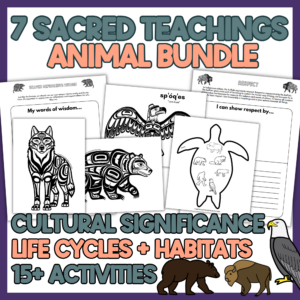
♥︎ Seven Sacred Teachings Animal Activity Bundle
♥︎ Seven Sacred Teachings Bulletin Board
♥︎ Seven Sacred Teachings Métis Dot Art Activity
♥︎ The Seven Sacred Teachings Children’s Book
IMPORTANT INFORMATION
The resources provided here are designed to support the teaching of Indigenous cultures, including First Nations, Métis, and Inuit peoples. It is important to recognize that these communities are not monolithic; beliefs, traditions, and practices vary greatly from Nation to Nation, and even from community to community. The content shared in these materials reflects my own lived experience and understanding of Indigenous cultures, but it does not encompass the full diversity or richness of these traditions.
I encourage educators to approach these resources with respect, sensitivity, and openness to learning. When possible, please engage with local Indigenous communities or cultural experts to ensure that the information shared is accurate and culturally appropriate for the specific Nations or groups you are teaching about.
These resources are intended to foster understanding and appreciation for Indigenous people.
Reviews
There are no reviews yet.