94 Calls to Action activities can help students move beyond simply hearing the words “Truth and Reconciliation” and begin to understand what reconciliation actually asks people, governments and institutions to do. The Truth and Reconciliation Commission of Canada released the 94 Calls to Action in 2015 after years of listening to Residential School Survivors, families and communities. The Calls address the ongoing impacts of residential schools and identify concrete actions needed to advance reconciliation in Canada.
For students, that can feel like a very big topic. But they do not need to understand all 94 Calls at once. Whether you’re introducing the Calls to Action to primary students or asking older students to investigate one in more depth, there are meaningful and age appropriate ways to bring this learning into your classroom.
What Are the 94 Calls to Action?
The Truth and Reconciliation Commission’s 94 Calls to Action are recommendations intended to address the legacy of residential schools and move reconciliation forward in Canada. They cover areas including child welfare, education, language and culture, health, justice, government, museums, media, sports and business.
This is important for students to understand because the Calls to Action are not simply a list of things to learn about residential schools. They ask governments, institutions, organizations and people across Canada to make changes. This gives students an opportunity to think about reconciliation as something that involves action, not simply awareness.
Education Is Part of the Calls to Action
There is another reason the Calls to Action belong in classrooms: education is directly included. Calls to Action 62 through 65 focus specifically on Education for Reconciliation, including age-appropriate learning about residential schools, Treaties and the historical and contemporary contributions of Indigenous Peoples.
That means Indigenous education is not something extra teachers are adding to the curriculum because September 30 is approaching. Education is part of the work of reconciliation itself, and that learning can begin in age-appropriate ways from the early grades onward.
94 Calls to Action Activities for Primary Students
Younger students certainly do not need to read and analyze all 94 Calls independently. They can, however, begin to understand why the Calls exist and what reconciliation can look like.
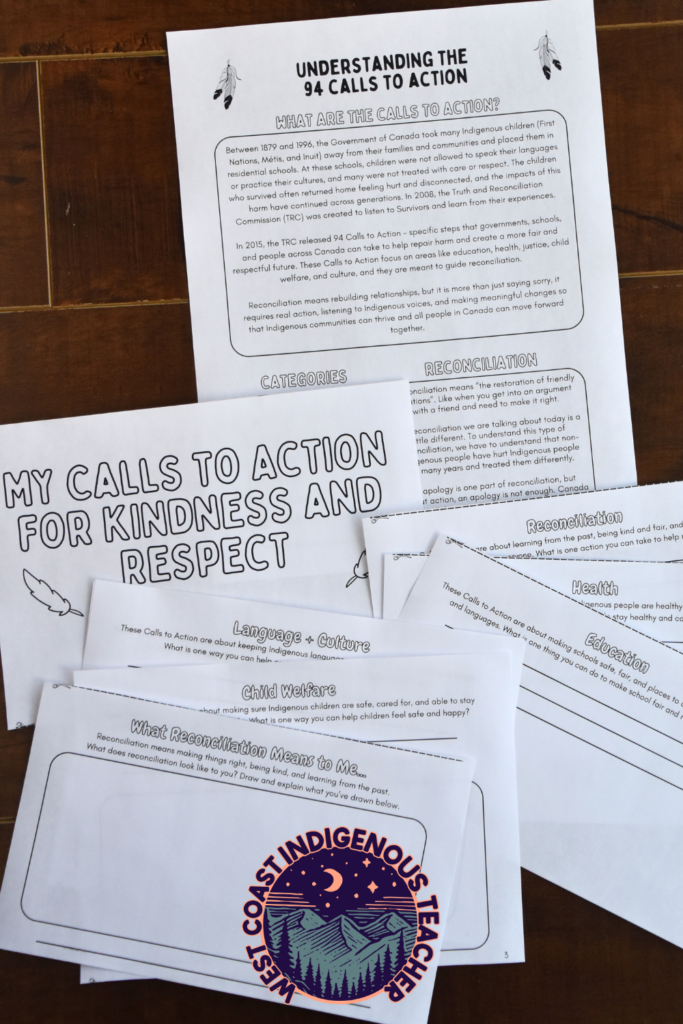
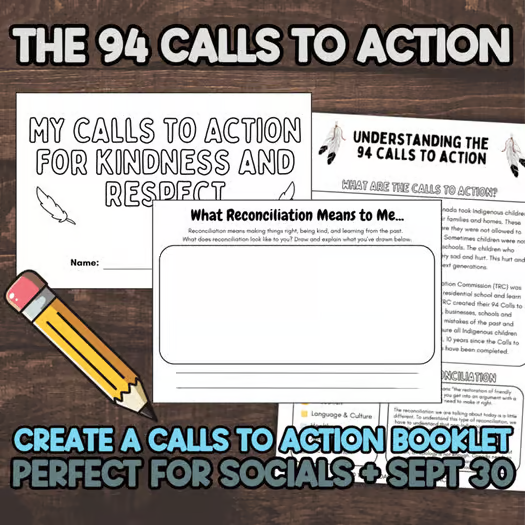
My 94 Calls to Action for Primary Students resource introduces the Calls in language designed for younger learners. Students learn what the Calls to Action are, explore some of the areas they address and begin thinking about ideas such as fairness, listening, protecting language and culture, and making things better for future generations.
The resource includes a four-page introduction to the 94 Calls to Action, an overview of the categories, a complete checklist of all 94 Calls and a nine-page student mini booklet with writing and drawing opportunities. Rather than expecting young students to understand complicated policy language, it gives them an accessible starting point for conversations about Truth and Reconciliation.
Explore the Primary 94 Calls to Action Resource
94 Calls to Action Research Project for Older Students
Older students are ready to ask harder questions. Instead of simply reading through the Calls to Action, they can choose one and investigate what it means, why it was needed and what progress has been made.
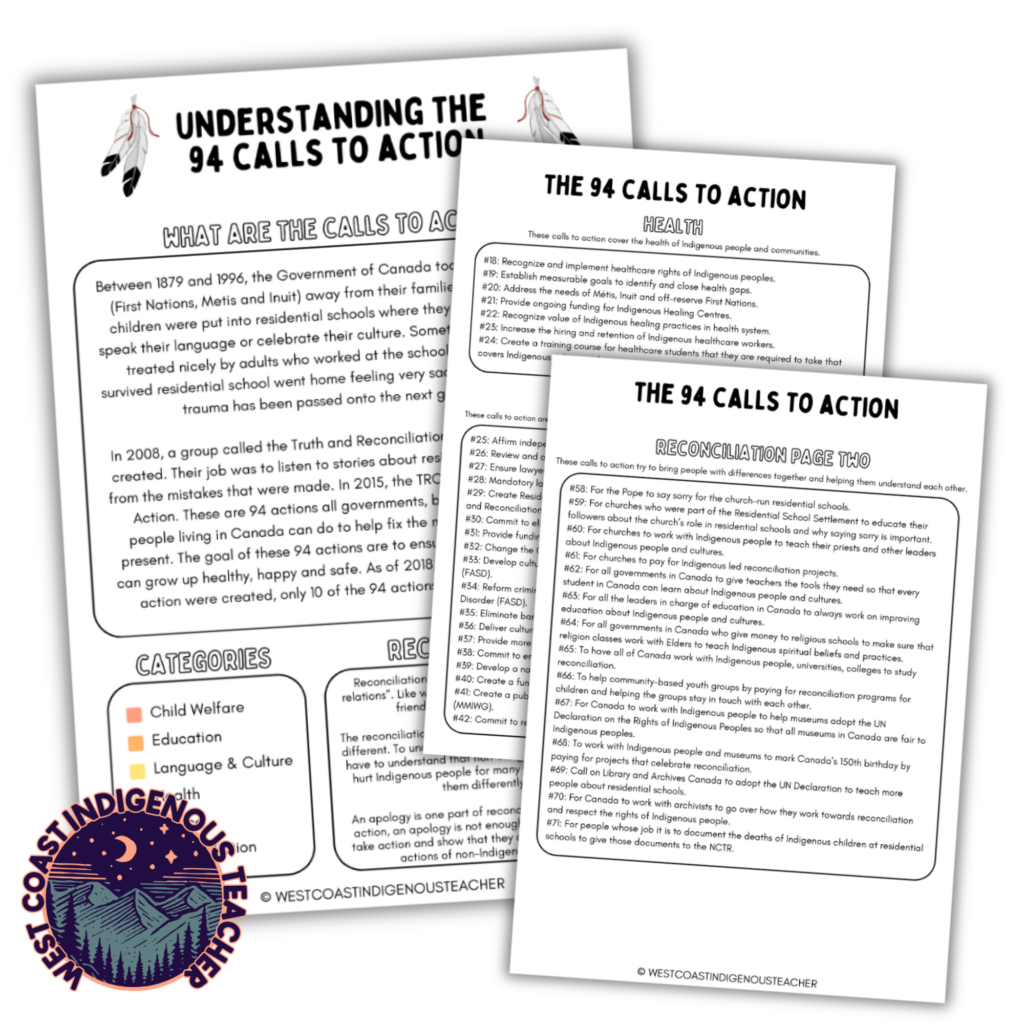
My 94 Calls to Action Research Project for Grades 5+ gives students a structured way to do exactly that. The resource includes an introduction to the 94 Calls to Action, the full list of Calls, a checklist and a guided research project.
Students choose a Call to Action and investigate questions such as: What is this Call asking for? Why was it necessary? Who is responsible for acting on it? What progress has been made? What work still needs to happen?
That last question is especially important. Instead of treating the 94 Calls to Action as a historical document students simply need to know exists, the project encourages them to understand reconciliation as ongoing work.
Explore the Grades 5+ 94 Calls to Action Research Project
Connect the Calls to Action to the Present Day
One of the most meaningful parts of teaching the 94 Calls to Action for students is helping them understand that this work is still happening.
Older students can investigate what progress has been made since the Calls were released in 2015. Has a particular Call been completed? Is work underway? Who is responsible for it? What has changed, and what still needs to happen?
Because progress changes over time, I encourage students to look at current Indigenous-led and official sources rather than relying only on an old progress checklist. This can also lead to important conversations about what “completed” actually means. A law may have changed while implementation is still ongoing, or different organizations may assess progress differently.
Those are valuable conversations for students who are ready to think more critically about reconciliation.
Go Beyond September 30
The 94 Calls to Action activities also give teachers a natural way to continue learning after Orange Shirt Day. September 30 can introduce students to residential schools, Survivors and the importance of Truth and Reconciliation, but the learning should not end on October 1.
The Calls to Action provide an obvious next step. You might introduce them in October and return to them throughout the year as different topics arise. Students could explore an education-related Call during social studies, investigate language revitalization during literacy or research Calls connected to media, sports or government later in the year.
The goal is not to create one enormous reconciliation unit. It is to allow Indigenous education and conversations about reconciliation to continue throughout the school year.
From Awareness to Action
One question I like students to consider is: What is the difference between learning about reconciliation and participating in reconciliation?
Students are not responsible for solving the 94 Calls to Action. Many of the Calls are directed specifically toward governments, institutions and organizations. But students can still learn why the Calls exist, ask questions, listen to Indigenous voices and understand why change is being requested.
They can also learn about the Indigenous Nations and communities around them, notice whose perspectives are being included in what they read and share what they have learned with others. These are important steps toward understanding why reconciliation requires more than wearing an orange shirt once a year.
Teaching the 94 Calls to Action Respectfully
When introducing this topic, context matters. Students should understand that the Calls to Action came from the work of the Truth and Reconciliation Commission and from the truths shared by Residential School Survivors, families and communities.
It is also important to avoid presenting Indigenous Peoples as one group with one shared experience. First Nations, Métis and Inuit Peoples have distinct histories, cultures, languages and experiences with colonial policies.
Whenever possible, include Indigenous-created sources, connect learning to local Indigenous Nations and provide context before asking students to complete an activity. Include present-day Indigenous voices and experiences, and avoid framing reconciliation as something that has already been completed.
The goal is not to have students memorize 94 numbered statements. The goal is to help them understand why the Calls were made and why they still matter.
Explore 94 Calls to Action Activities for Students
If you’re looking for ready-to-use 94 Calls to Action activities, I currently have two options depending on the age of your students.
For younger learners, the 94 Calls to Action Primary Resource offers an age-appropriate introduction with a student booklet, writing, drawing and reflection.
For older students, the 94 Calls to Action Research Project for Grades 5+ gives students an opportunity to choose one Call, investigate its purpose and progress, and think more deeply about the work that still needs to happen.
Whether students are encountering the Calls to Action for the first time or are ready to investigate reconciliation in more depth, the important thing is that the learning does not stop at awareness. Truth matters, and reconciliation asks us to consider what comes next.