If you have ever wanted an Orange Shirt Day activity that gets your entire class involved, creates a meaningful finished display, and does not require you to cut out 487 tiny decorative pieces after Orange Shirt Day Activity: A Collaborative Poster for Truth and Reconciliation
If you have ever wanted an Orange Shirt Day activity that gets your entire class involved, creates a meaningful finished display, and does not require you to cut out 487 tiny decorative pieces after school… this one is for you.
Meet my Orange Shirt Day Collaborative Poster.
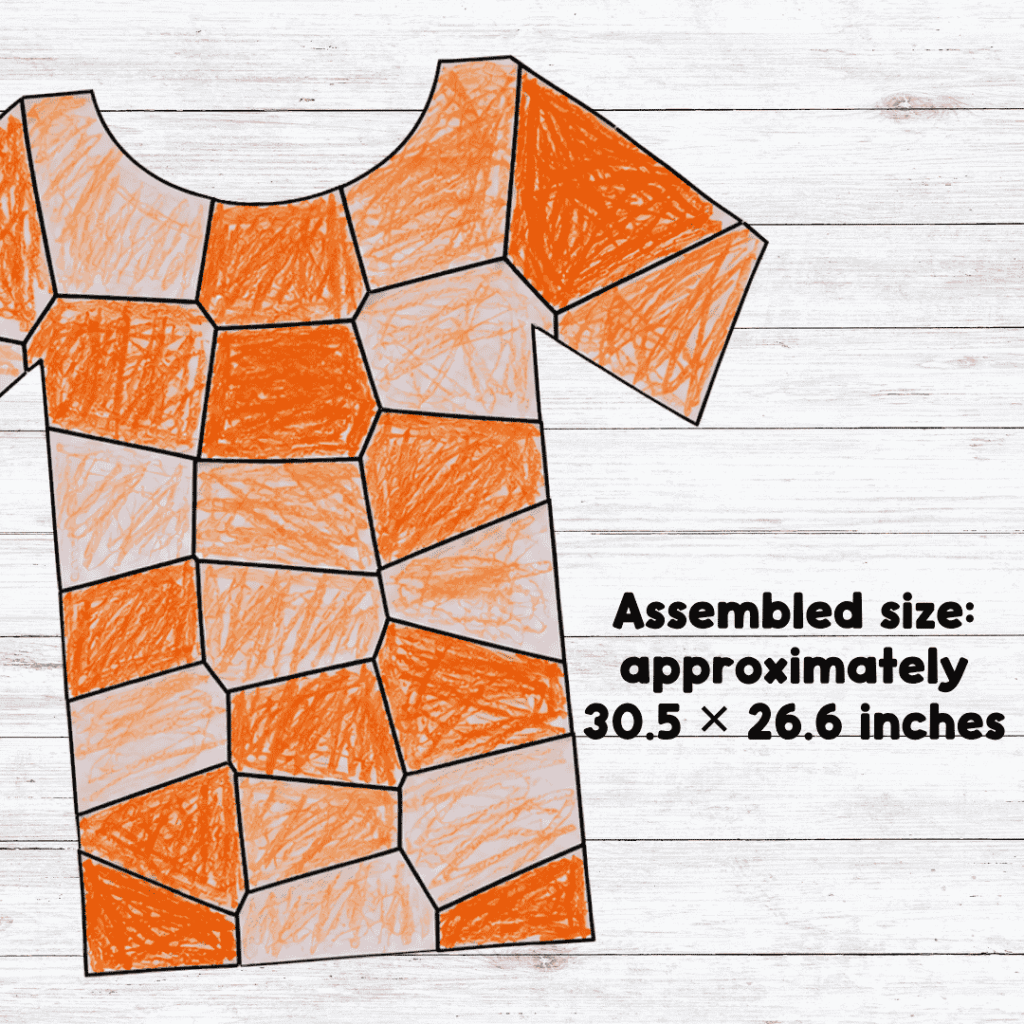
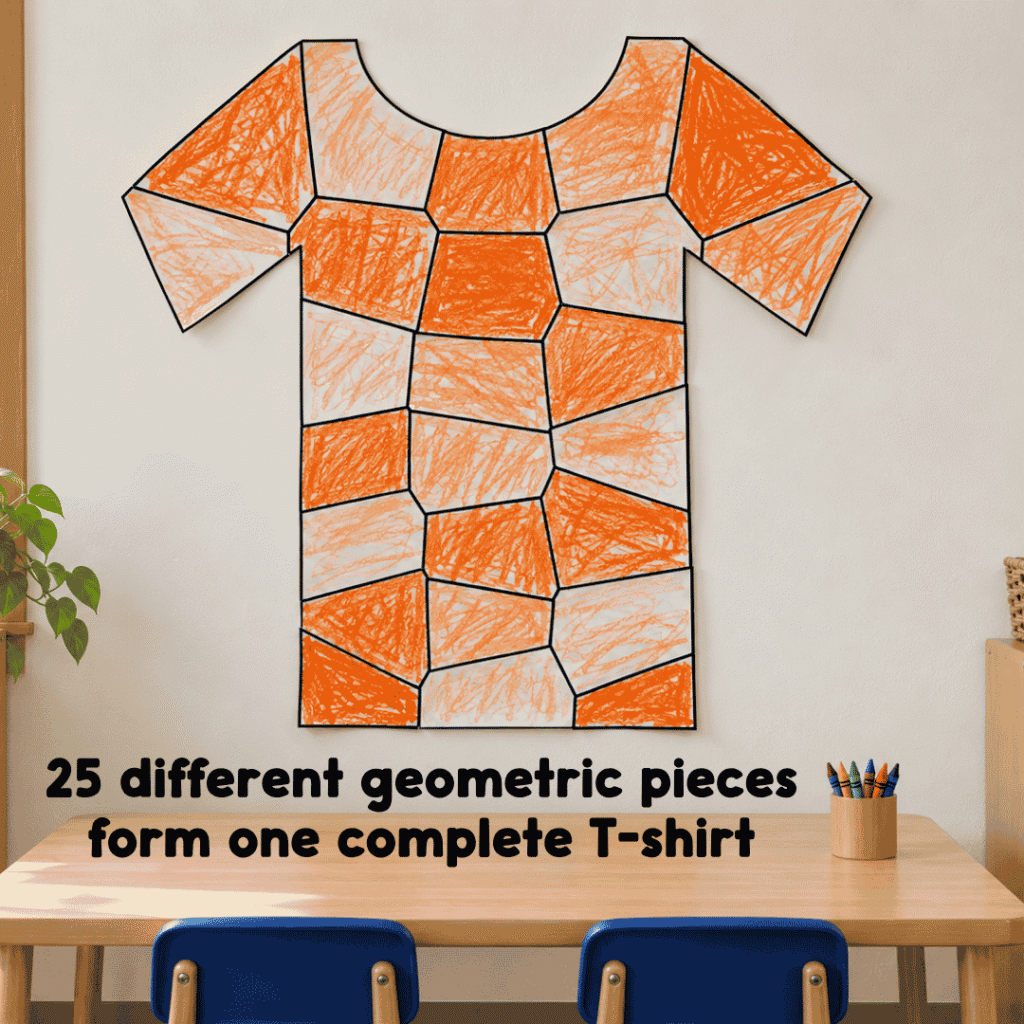
It starts as 25 individual puzzle pieces.
It ends as one giant orange T-shirt measuring approximately 30.5 inches wide by 26.6 inches tall.
And somewhere in between, every student gets to add their own little piece to the final project.
Literally.
I love a good classroom activity with a metaphor built right in.
A Collaborative Orange Shirt Day Activity for the Whole Class
This printable Orange Shirt Day activity was designed to give every student a way to participate in a shared classroom project while making space for conversations about belonging, identity, safety and care.
Each student receives one piece of the poster.
Depending on the version you choose, students can colour it, add their name, or respond to a simple reflection prompt.
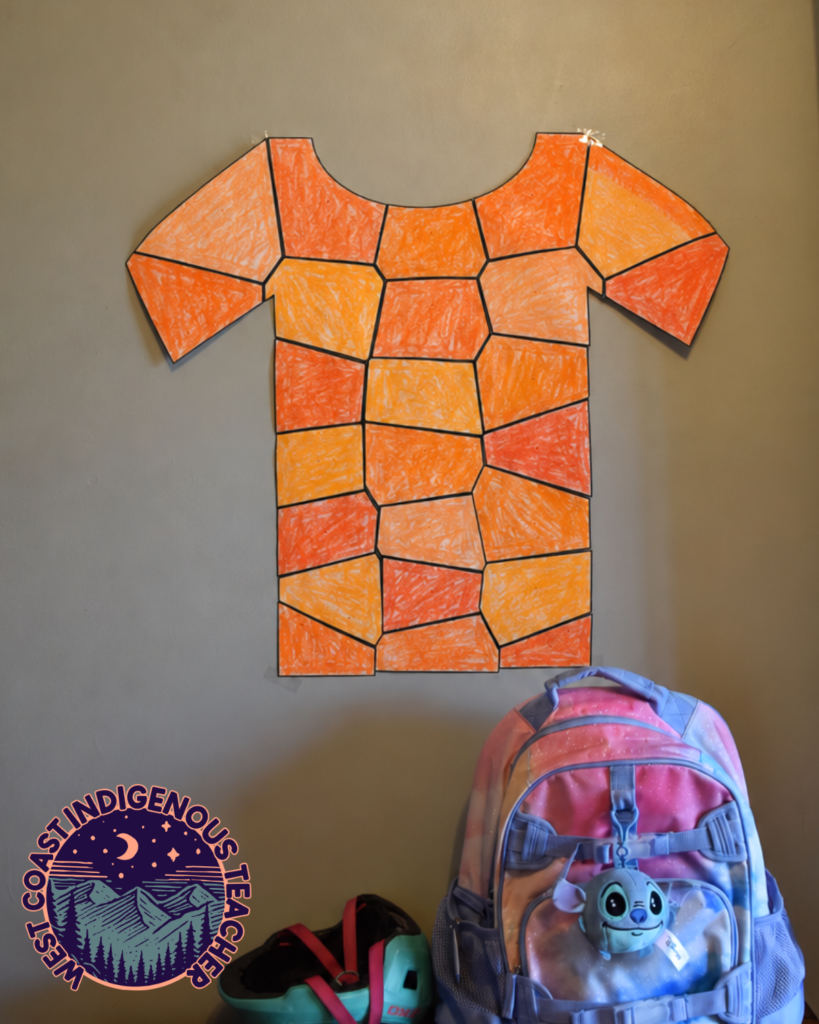
Once everyone has finished, the 25 individual pieces are assembled to create one large orange T-shirt.
The finished collaborative poster can become an Orange Shirt Day bulletin board, hallway display, classroom wall display or part of your September 30 learning.
And yes, it is BIG.
Not impossibly-cover-your-entire-classroom-wall big.
But definitely big enough that students get that very satisfying “WAIT… we made THAT?!” moment when all the pieces finally come together.
Three Orange Shirt Day Activity Options Are Included
Not every class needs the same activity.
Kindergarten students and Grade 5 students probably should not be staring at the exact same writing prompt wondering what you want from them.
So I included three different versions of the collaborative poster.
1. Colouring Version
This is the simplest option and works especially well for younger students.
Each child receives a blank puzzle piece to colour orange. Students can use crayons, pencil crayons or markers and make their piece their own.
The slightly different shades, colouring styles and very enthusiastic crayon pressure are actually part of what makes the finished poster so good.
Twenty-five perfectly identical orange puzzle pieces?
No thank you.
Twenty-five pieces that very obviously came from 25 different little humans?
Much better.
Once the pieces are finished, students cut them out and the class assembles the giant shirt.
2. Name Version
In this version, each student writes their name on their puzzle piece before colouring and decorating it.
This opens the door to conversations about identity and belonging.
Every name belongs.
Every student contributes.
And when all of those individual pieces are put together, they become part of something larger.
It is a very simple activity, but that visual can lead to a meaningful classroom discussion.
3. “Every Child Deserves…” Writing Prompt
The third version turns the collaborative poster into an Orange Shirt Day writing activity.
Students respond to:
Every child deserves…
Depending on their age, they might write one word, a short sentence or communicate their thinking through a drawing.
Some responses might include:
- safety
- family
- love
- friends
- kindness
- a home
- care
- their culture
- their language
- to feel like they belong
After reflecting, students colour and cut their pieces before adding them to the class poster.
For younger students, this can be as simple as talking through the question together and having children draw their response.
For older elementary students, it can lead into a deeper conversation about the rights of children and what Indigenous children were denied through the residential school system.
More Than an Orange Shirt Day Craft
I love hands on learning.
I love collaborative art.
I really love a bulletin board that practically makes itself.
But an Orange Shirt Day craft should never become the entire lesson.
This collaborative poster is meant to be used alongside age appropriate learning about residential schools, Survivors and the meaning of September 30.
The National Day for Truth and Reconciliation takes place each year on September 30 and honours Survivors, the children who never returned home, their families and their communities.
For students, that learning will look different depending on their age.
With very young children, conversations may focus more heavily on ideas they can understand: family, safety, belonging, culture, language and being cared for.
Older students can begin learning more directly about residential schools, their purpose, their impacts and the experiences of Survivors.
The poster then becomes a way for students to respond to learning, rather than replacing the learning itself.
An Orange Shirt Day Bulletin Board Made by Your Students
One of my favourite things about collaborative classroom projects is that the final display actually belongs to the students.
You are not printing a cute poster and stapling it onto the bulletin board at 4:47 p.m.
Your students made it.
Their colouring is on it.
Their names might be on it.
Their thinking might be on it.
Their individual pieces are visibly connected.
Once assembled, the approximately 30.5 × 26.6 inch collaborative poster is large enough to become the centrepiece of an Orange Shirt Day bulletin board or Truth and Reconciliation classroom display.
You could display it on its own or surround it with student writing, books you are reading, learning questions or other classroom reflections from your September 30 learning.
It also works well in a hallway or shared school space where other students and families can see what your class has been learning.
What Is Included in the Orange Shirt Day Collaborative Poster?
I wanted this one to be as close to print it and figure it out without needing a degree in puzzle engineering as possible.
Inside the resource you will find:
- 25 individual poster pieces
- 3 complete activity versions
- a blank colouring version
- a student name version
- an “Every child deserves…” reflection version
- varied geometric puzzle pieces
- thick black cutting outlines
- small numbers on each piece to make assembly easier
- a numbered assembly guide
- teacher printing instructions
- teacher assembly directions
- standard 8.5 × 11-inch printable pages
When printed at 100% / Actual Size, the completed shirt measures approximately 30.5 inches wide × 26.6 inches tall.
How to Use This Truth and Reconciliation Activity
The prep is intentionally simple.
First, choose your version.
Decide whether your students will colour, write their names or respond to the writing prompt.
Next, print the 25 pieces.
Print on standard 8.5 × 11-inch paper using Actual Size or 100% so all of the pieces maintain the correct scale.
Then, give each student a piece.
For a class smaller than 25, some students can complete more than one piece.
Have students complete their reflection or colouring before cutting through the middle of the thick black outline.
Finally, assemble your poster.
Use the numbered guide to match the pieces.
Tape the joins together from the back or mount the individual pieces onto bulletin board paper or another backing.
And then comes the best part:
Stand back.
Admire giant shirt.
Pretend you absolutely knew it would line up perfectly the entire time.
Using the Poster Beyond September 30
Although this makes a meaningful September 30 classroom activity, learning about Indigenous Peoples should not begin and end with Orange Shirt Day.
Your finished poster can stay displayed after September 30 as a reminder that Truth and Reconciliation is not a one-day classroom topic.
You can continue learning about:
Indigenous Peoples in the present day.
The First Nations, Inuit and Métis communities connected to where you live.
Indigenous authors and illustrators.
Local Nations and languages.
Indigenous art, knowledge and perspectives.
The Truth and Reconciliation Commission’s Calls to Action.
And the many ways Indigenous Peoples continue to contribute, create, lead and thrive today.
Orange Shirt Day can be an important part of the learning.
It does not need to be the end of it.
Looking for an Orange Shirt Day Activity for Your Classroom?
If you want a Truth and Reconciliation activity that combines student reflection, collaborative art and a classroom display, this giant puzzle poster was made for exactly that.
With three differentiated versions and 25 individual student pieces, you can choose the option that works best for your class while giving every student a visible role in the final project.
Print.
Colour.
Reflect.
Cut.
Assemble.
And watch 25 seemingly random pieces
Shop the Orange Shirt Day activity in Canadian dollars here!
Or if you’d rather USD, shop here!