
Planning an Indian Act lesson plan can feel overwhelming. It is a complicated piece of Canadian legislation with a long history and ongoing impacts. Teachers want students to understand it, but turning more than a century of laws, policies and amendments into one clear lesson is not exactly a small Tuesday afternoon planning task.
Still, the Indian Act is an important part of understanding Canadian history, residential schools, colonization and Truth and Reconciliation.
Students do not need to understand every section of the legislation. They do need an age appropriate explanation of what it is, why it was created, who it affects and why it still matters today.
What Is the Indian Act?
The Indian Act is a Canadian federal law that was first passed in 1876. It brought together earlier colonial laws and gave the federal government extensive control over many areas of First Nations life.
Historically, the Indian Act affected identity, land, governance, cultural practices, education and who the government legally recognized as having Indian Status.
It is important to explain to students that the word Indian appears here because it is the legal name of the legislation. Many Indigenous people consider the term outdated and offensive outside of specific legal or historical contexts.
It is also important to be accurate about who the Act affects. The Indian Act applies specifically to many First Nations people, including people who are eligible to be registered under the Act. It does not apply to Métis or Inuit Peoples.
Although the Indian Act has been amended many times, it is not simply a historical document. It remains in effect today. The current legislation continues to address areas such as registration, First Nations bands and reserve lands. Teachers can view the current version through the Government of Canada’s Justice Laws website.
Why Students Should Learn About the Indian Act
Many students learn about residential schools and Orange Shirt Day without learning about the larger system of laws and policies that made those institutions possible.
The Indian Act helps students connect those pieces.
In 1920, the Act was amended to make attendance at residential schools compulsory for many First Nations children between the ages of seven and fifteen. The National Centre for Truth and Reconciliation provides additional information about this history.
Learning about the Indian Act can help students understand that residential schools were not isolated events. They were connected to a much larger colonial system that attempted to control First Nations identities, families, lands, governments and cultural practices.
This does not mean students need to learn every difficult detail at once. It means we give them enough truthful context to understand that these harms did not happen accidentally.
Before Teaching the Indian Act
A meaningful Indian Act lesson plan should do more than give students a list of dates and rules.
Here are a few things to keep in mind before beginning.
Be Clear About Who the Act Applies To
First Nations, Métis and Inuit Peoples are distinct Indigenous Peoples with their own cultures, histories, languages and rights.
The Indian Act does not apply equally to all Indigenous Peoples in Canada. It specifically concerns many First Nations people, bands and reserve lands.
That distinction matters. It helps students avoid treating all Indigenous experiences as interchangeable.
Explain the Language
Students may be confused or uncomfortable when they hear the word Indian.
Explain that this is the official legal name of the legislation. It is not a general term students should use to describe Indigenous people.
This creates a useful opportunity to discuss how language reflects the time and power structures in which laws were created.
Teach the Purpose, Not Only the Details
Students should understand that the Indian Act gave the Canadian government control over many aspects of First Nations lives.
Specific policies and amendments matter, but students also need to see the larger purpose and pattern. Ask them to consider:
- Who created this law?
- Who was affected by it?
- Who was given decision making power?
- Whose voices and rights were ignored?
- What happens when one group creates laws to control another?
These questions help students move beyond memorizing facts and begin thinking about power, fairness and responsibility.
An Indian Act Lesson Plan for Primary Students
Younger students can begin with the central idea that the government created a law that controlled choices First Nations people and communities should have been able to make for themselves.
They do not need an exhaustive list of policies. Focus on understandable ideas such as fairness, identity, family, culture and decision making.
Primary students can explore questions such as:
- Who should make decisions about a community?
- Is a law automatically fair just because it is a law?
- How might it feel if someone else made decisions about your identity?
- Why is it important for communities to protect their cultures and languages?
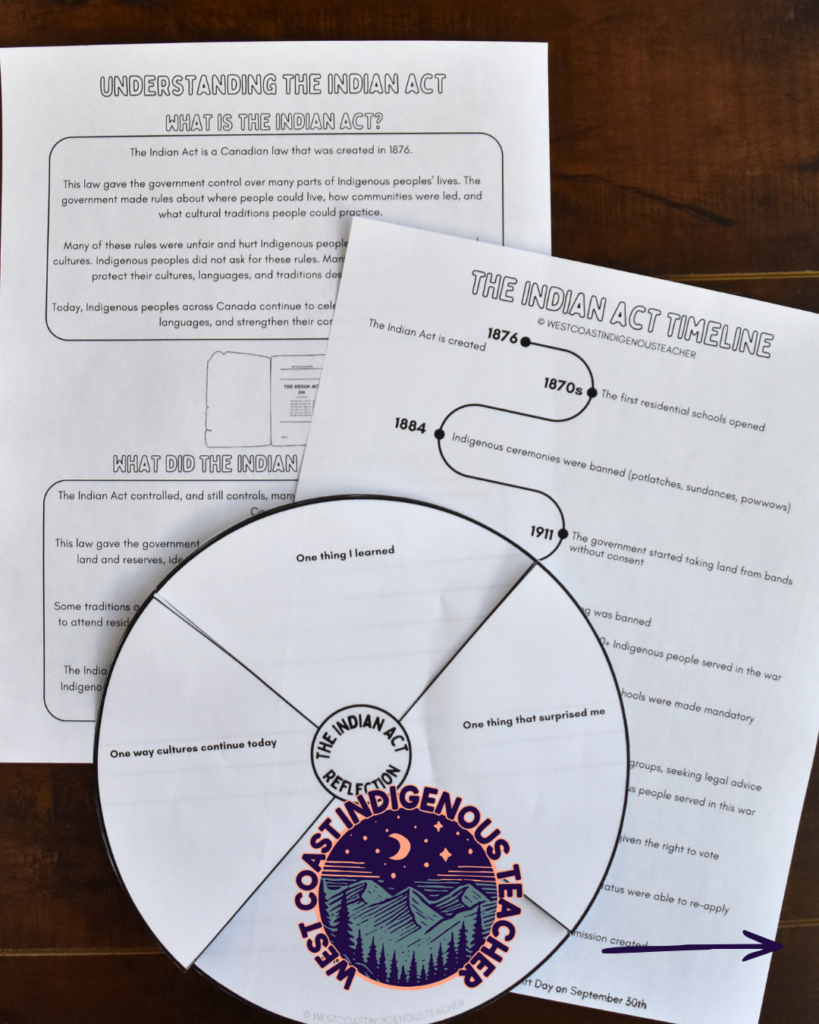
My ready to use Indian Act Lesson for Primary Students introduces the topic using age appropriate language and manageable steps.
It includes:
- A three page Indian Act lesson
- A student friendly timeline
- An impacts of the Indian Act cut and sort activity
- An interactive reflection activity
- Two hands on activities for younger learners
The goal is not to simplify the truth until it loses its meaning. It is to give younger students an honest foundation they can build on in later grades.
Indian Act Activities for Intermediate Students
An Indian Act lesson plan for intermediate students can move beyond the basic definition and explore how the legislation affected First Nations individuals, families and communities.
At this level, students can begin examining specific areas of control and discrimination, including identity, governance, land, cultural practices and the treatment of First Nations women.
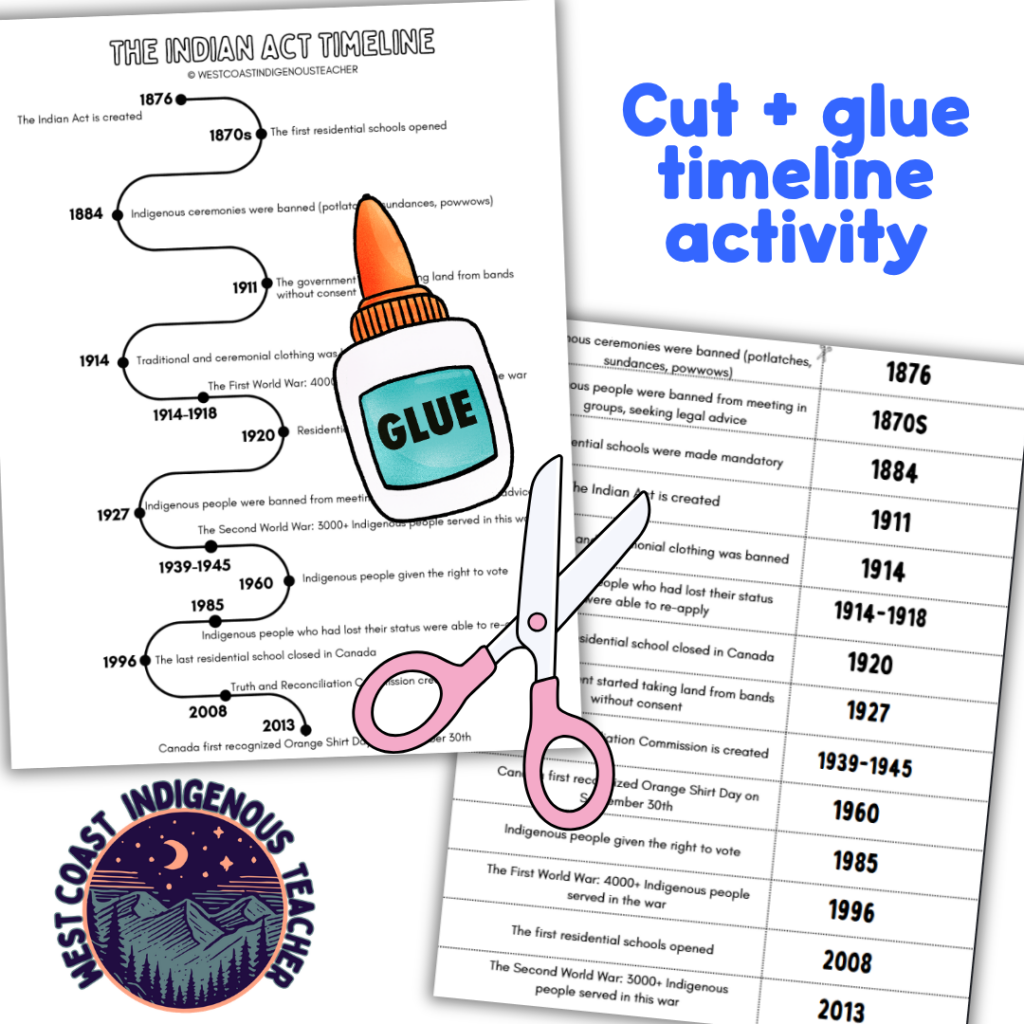
The Indian Act Lesson and Activities for Intermediate Students includes:
- A complete six page Indian Act lesson
- The history and purpose of the Act
- Historical and ongoing impacts
- An Indian Act timeline
- Learning about discrimination against First Nations women
- Five printable Indian Act activities
- Reflection and response opportunities
A timeline is especially useful at this level because it shows students that the Indian Act did not remain unchanged. Policies were introduced, challenged, removed and amended over time.
Students can then consider a larger question: What happens when discrimination is written into law, even if that law is later changed?
An Indian Act Lesson for Middle and High School
Middle and high school students can explore how the Indian Act was used as a tool of colonization and how it affected First Nations identity, governance, culture and families. They can also examine its connections to residential schools, sex based discrimination, resistance and self-determination.
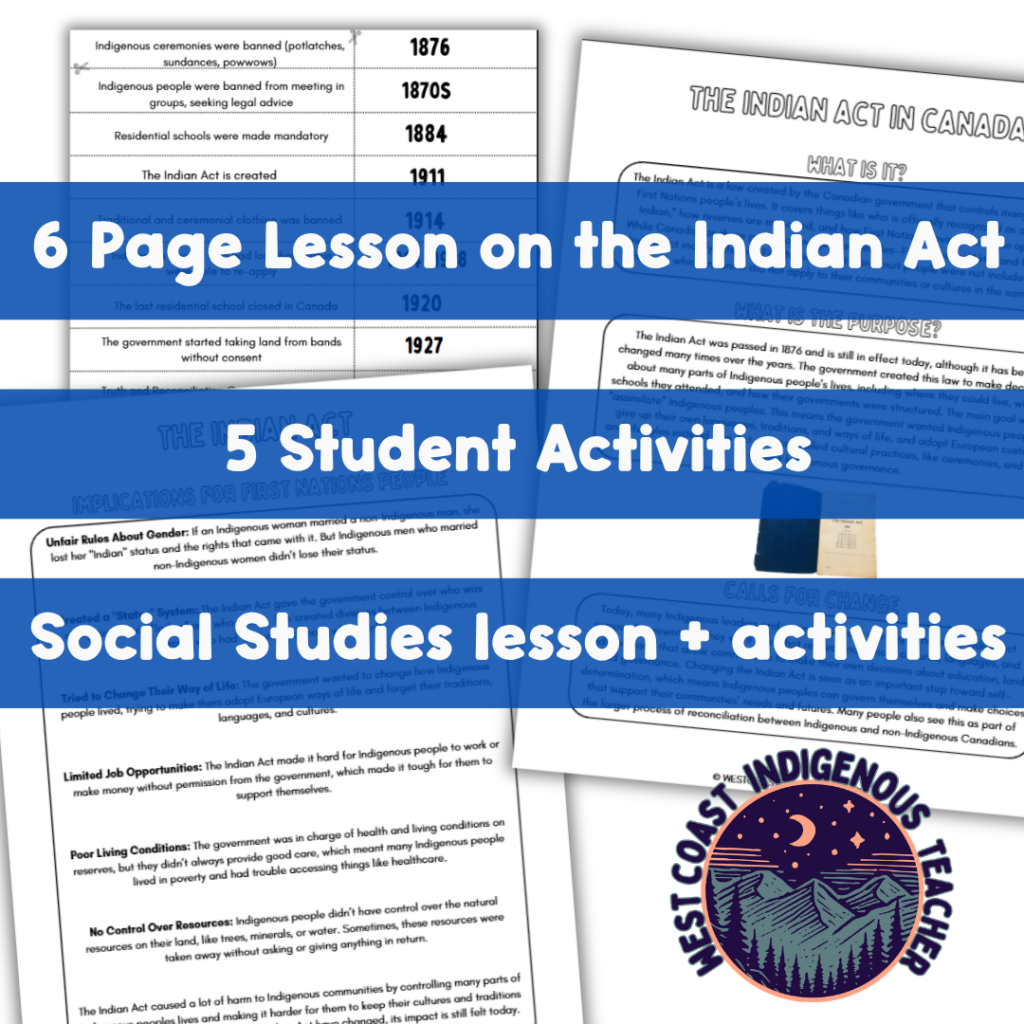
My Indian Act Lesson for Middle and High School includes a six page lesson, timeline, vocabulary work, reflection questions, case study and creative response. These activities help students investigate the legislation with more depth while giving them different ways to demonstrate their understanding.
Connecting the Learning
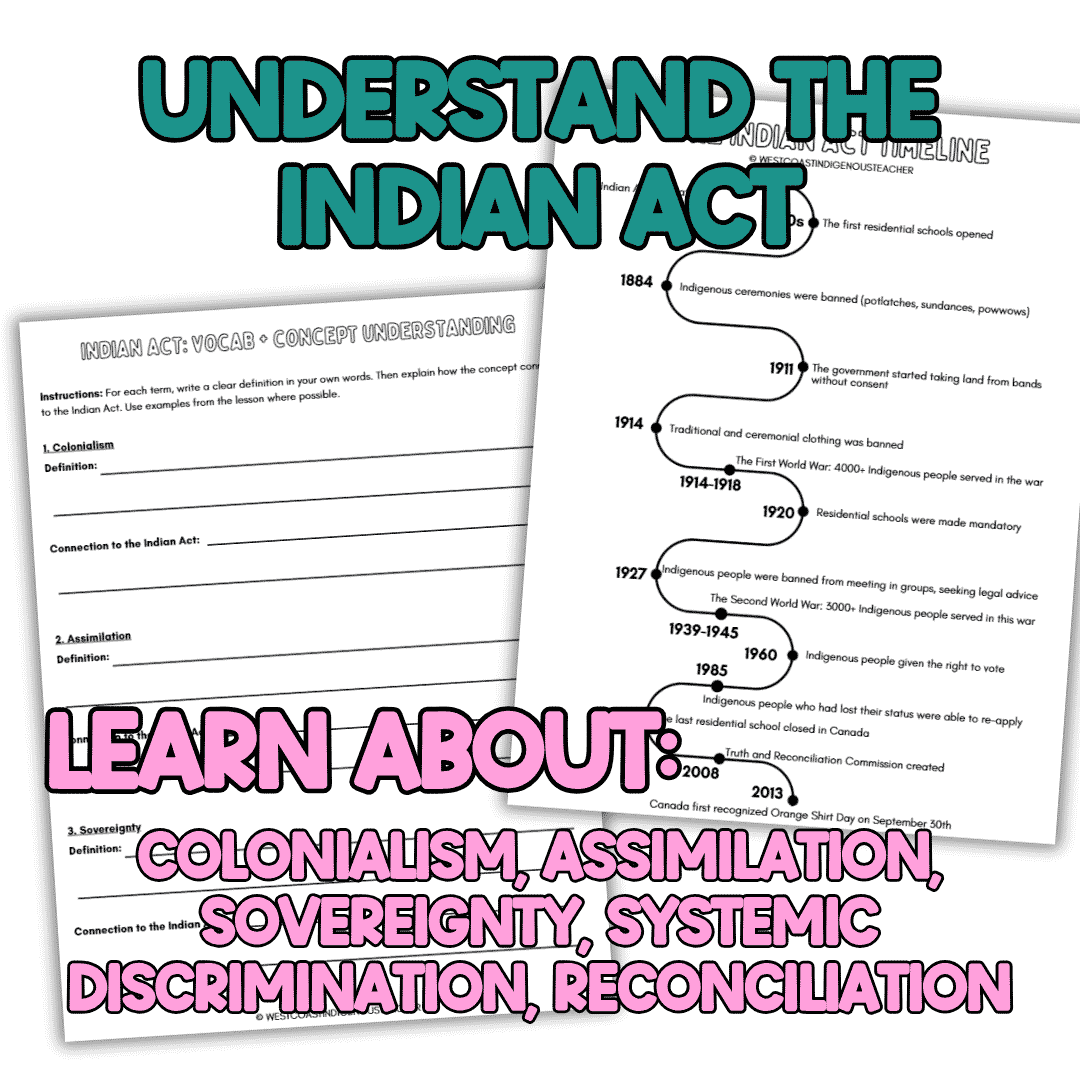
An Indian Act lesson plan can fit naturally into learning about Canadian history, government, colonization, residential schools, human rights and Truth and Reconciliation. It can help students see that these subjects are connected, rather than a collection of separate events.
The Indian Act is only one part of Indigenous education. Students also need opportunities to learn about living First Nations cultures, contemporary communities, leadership, language revitalization and relationships with the land. From here, classes might explore the 94 Calls to Action, treaty relationships or the Nations whose lands their school is on.
For more ways to continue the learning, read Orange Shirt Day Activities Beyond Crafts.
Indian Act Lessons for Every Grade
You do not need to hand younger students a dense piece of federal legislation and hope for the best.
Each of my Indian Act resources was created to make this learning more manageable while keeping the historical context and ongoing impacts at the center.
Choose the option that best fits your students:
- Indian Act Lesson for Primary Students
- Indian Act Lesson and Activities for Intermediate Students
- Indian Act Lesson for Middle and High School
As a First Nations educator, I want teachers to feel supported when approaching topics that can feel difficult or unfamiliar. You do not have to know every detail before you begin.
Start with accurate information. Be honest about what you are still learning. Make room for First Nations voices. Then help your students understand that this history is connected to the Canada they live in today.
A Final Thought
Teaching the Indian Act is not about fitting 150 years of history into one afternoon or expecting students to remember every amendment. It is about helping them understand how laws and government decisions have shaped the lives of First Nations people, and why those impacts are still felt today.
You do not need to have every answer before you begin. Start with accurate, age appropriate information, make room for thoughtful questions and keep learning alongside your students.
This can be a difficult part of Canadian history to teach, but leaving it out does not make it less important. Giving students a truthful place to begin is a meaningful step forward.